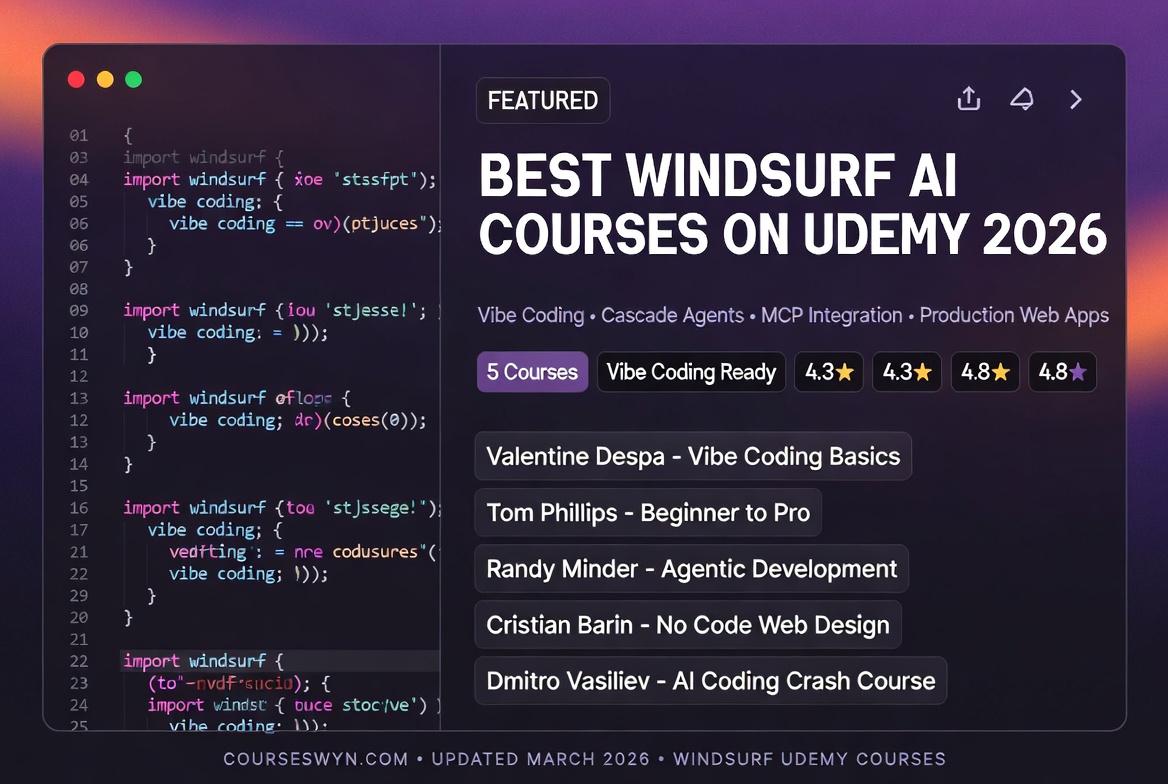
Why Learn Windsurf and Vibe Coding in 2026?
Windsurf (from Codeium) has established itself as the industry-standard AI-native IDE for autonomous application development in 2026. The platform enables developers and non-technical professionals to architect, implement, test, and deploy production-grade applications using natural language specifications—a paradigm shift known as vibe coding.
Unlike traditional AI-assisted development tools, Windsurf provides full-project context understanding, MCP (Multi-Context Protocol) integration support, custom rules, authentication flows, payment processing, and agentic workflows capable of planning 10+ sequential steps.
This represents a fundamental shift in development methodology. Rather than writing code syntax, developers articulate application intent and behavior in natural language, allowing autonomous agents (Cascade) to handle implementation details.
According to developer reports, Windsurf users achieve 5–10× acceleration in development velocity. Non-technical founders have successfully launched production applications within 48 hours using Windsurf’s no-code capabilities.
How We Selected These Courses
Our selection criteria ensure comprehensive, high-quality recommendations:
- Verified ratings ≥4.0 and minimum 149 enrollments (as of March 2026)
- Updated November 2025–March 2026 (reflects Cascade improvements, MCP integration patterns, production deployment practices)
- At least 60% curriculum focused on Windsurf application development (not general AI coding)
- Real-world projects demonstrating production applications, not tutorials
- Renowned instructors with active community support
- Practical focus on vibe coding methodology and autonomous agent orchestration
Windsurf Courses in 2026: What Actually Matters (Expert Perspective)
By 2026, the biggest mistake learners make with Windsurf is treating it like a code autocomplete tool.
In production environments, autonomous development requires far more than code generation:
- Vibe specification – How to articulate application intent in natural language that yields production-ready implementations
- Cascade orchestration – Managing autonomous agent planning, execution, and error recovery across multi-step projects
- MCP integration patterns – Connecting Windsurf to PostgreSQL, Stripe, authentication systems, and external APIs
- Custom rules frameworks – Enforcing architectural patterns, security standards, and code quality without manual oversight
- Production deployment – Transitioning from Windsurf-generated code to scalable, maintainable systems
- Refactoring and maintenance – Modifying AI-generated applications without disrupting functionality
Most Udemy courses only demonstrate what Windsurf can do.
The courses ranked below were selected based on how well they teach production-grade autonomous development, not just feature demonstrations.
Best Udemy Windsurf Courses (2026)
1. Windsurf: From Vibe Coding Basics to AI-Powered Development (Valentine Despa)
Why This Course Ranks #1 in 2026
This course ranks #1 because it uniquely treats Windsurf as a comprehensive development methodology, not a tool.
It stands out for:
- Deep, practical coverage of vibe coding methodology beyond surface-level feature introduction
- Systematic progression from fundamentals through production-grade applications
- Emphasis on Cascade agent orchestration for multi-step project execution
- Comprehensive MCP integration frameworks for connecting to production systems
- Portfolio-grade projects that mirror real-world application requirements
Best for: Developers seeking comprehensive mastery of Windsurf’s capabilities with production-ready skills.

Course Overview
This course provides the most comprehensive introduction to Windsurf’s core concepts and production-ready capabilities. It covers natural-language specification writing, Cascade agent mechanics, automated testing frameworks, and MCP integration—the essential competencies for productive autonomous development in 2026.
Curriculum Highlights
- Module 1: Windsurf Fundamentals – IDE architecture, workspace configuration, interface navigation
- Module 2: Vibe Coding Methodology – Writing effective natural-language specifications that yield production-ready code
- Module 3: Cascade Agent Mechanics – How autonomous agents decompose requirements, plan execution, and self-correct
- Module 4: Code Generation and Testing – Practical workflows from specification to tested implementation
- Module 5: MCP Integration Frameworks – Connecting to PostgreSQL, external APIs, and production dependencies
- Module 6: Custom Rules Configuration – Enforcing architectural patterns and security standards across projects
- Module 7: Production Deployment – Transitioning from Windsurf development to scalable applications
Strengths
- Systematic progression: Clear advancement from fundamentals through production patterns
- MCP expertise: Unique emphasis on production integration beyond basic documentation
- Practical implementation: Each module includes working examples with real code repositories
- Cascade specialization: Deep exploration of autonomous agent planning and execution
- Community validation: 1,658 students with sustained 4.5/5 rating across 323 verified reviews
- Instructor responsiveness: Valentine Despa actively supports student questions and projects
Learning Outcomes
Students completing this course will be able to:
- Architect complex applications using vibe coding methodology
- Leverage Cascade agents for multi-step project planning and execution
- Configure production-grade MCP integrations for external systems
- Implement custom rules ensuring consistent code quality and architectural patterns
- Build full-stack applications (front-end, back-end, database) through natural-language specification
- Deploy applications from Windsurf development to production environments
- Refactor and maintain AI-generated code without disrupting functionality
Ideal Students
- Software developers transitioning to AI-native development methodologies
- Technical teams evaluating Windsurf as primary development environment
- Freelancers seeking productivity advantage in project delivery
- Engineering managers building organizational standards for autonomous development
- Technical architects designing AI-first application infrastructure
Enrollment: 1,658+ | Rating: 4.5/5 (323 reviews) | Duration: 2h 35m | Lectures: 35 → Get Course: Windsurf: From Vibe Coding Basics to AI-Powered Development
2. Windsurf Beginner to Pro: Build Production Web Apps with AI (Tom Phillips)
Why It’s Special
This course delivers the highest-rated instruction (4.8/5) specifically focused on shipping production SaaS applications with Windsurf.
It uniquely delivers:
- Project-based curriculum with real deliverables
- End-to-end SaaS application development (Next.js 15, TypeScript, Stripe)
- Authentication and payment processing integration
- Highest instructor rating on the platform
- Direct applicability to freelance and startup environments
Best for: Developers building commercial applications and generating revenue from Windsurf-assisted development.

Course Overview
This project-based course focuses on production-ready application development. Students build and deploy a complete Next.js SaaS application (ProStoic journaling platform with AI-powered features) incorporating user authentication, payment processing, custom rules, and MCP integrations.
The capstone project demonstrates every critical component required for commercial web application delivery: user management, database design, payment integration, deployment pipeline, and production monitoring.
Curriculum Highlights
- Project Foundation – Application architecture and technology stack selection
- User Authentication – Implementation of secure auth flows (Auth0, Clerk integration)
- Database Design – PostgreSQL schema optimization for AI-generated features
- Payment Integration – Stripe setup, subscription management, error handling
- AI Features – Custom Cascade workflows for application-specific intelligence
- Frontend Implementation – Next.js 15 components with Tailwind CSS styling
- Deployment and Operations – Cloud hosting (Vercel), monitoring, scaling considerations
Strengths
- Highest rating on platform (4.8/5) reflecting exceptional instructional clarity
- Production focus: Every module maps to actual commercial requirements
- Technology currency: Uses 2026-standard Next.js, TypeScript, modern tooling
- Real deliverable: Students complete shipping application, not tutorial projects
- Freelancer-ready: Skills directly applicable to client projects and service offerings
- Payment expertise: Comprehensive coverage of monetization implementation
- Selective cohort: 149 students suggests rigorous quality standards
Learning Outcomes
Students completing this course will be able to:
- Design and architect production SaaS applications from specification to deployment
- Implement secure user authentication and authorization patterns
- Manage complex databases with AI-generated optimization
- Integrate payment processing for subscription and transaction management
- Deploy applications to production-grade hosting with monitoring
- Estimate development timelines and costs for client projects
- Refactor Windsurf-generated code for performance and maintainability
Ideal Students
- Independent developers and freelancers building commercial applications
- Startup founders validating product ideas with rapid prototyping
- Developers transitioning to autonomous development for faster shipping
- Product managers learning to build technical prototypes
- Developers specializing in SaaS architecture and deployment
Enrollment: 149+ | Rating: 4.8/5 (17 reviews) | Duration: 3.5 hours | Lectures: 24 → Get Course: Windsurf Beginner to Pro: Build Production Web Apps with AI
3. Learn AI / Agentic Application Development with Windsurf AI (Randy Minder)
Why Choose This Course
This course provides the most comprehensive exploration of autonomous application development paradigms, covering both web and mobile platforms.
It uniquely offers:
- Longest curriculum (7 hours) enabling thorough exploration
- Agentic systems architecture and multi-agent orchestration
- Cross-platform development (web applications and mobile)
- Advanced orchestration patterns for complex workflows
- Theoretical foundations alongside practical implementation
Best for: Advanced developers and technical architects designing sophisticated autonomous systems.

Course Overview
This course demonstrates how Windsurf enables truly autonomous application development through vibe coding methodology and AI orchestration principles. It explores how autonomous agents can plan multi-step workflows, execute complex logic, recover from failures, and coordinate with other agents.
The course uniquely covers both web and mobile platform development, enabling developers to build autonomous systems across diverse application domains.
Curriculum Highlights
- Module 1: Agentic Foundations – Planning algorithms, reasoning patterns, autonomous decision-making
- Module 2: Cascade Orchestration – Multi-step agent execution, state management, error recovery
- Module 3: Web Application Development – Building feature-rich applications with autonomous logic
- Module 4: Mobile Application Development – iOS/Android development using Windsurf and autonomous agents
- Module 5: Multi-Agent Coordination – Multiple agents collaborating toward complex objectives
- Module 6: Advanced Patterns – Self-improving systems, reinforcement through feedback, creative workflows
- Module 7: Production Considerations – Error handling, monitoring, cost optimization at scale
Strengths
- Comprehensive depth: 7 hours provides thorough exploration of agentic principles
- Theoretical grounding: Explains why agentic patterns work, not just implementation
- Cross-platform scope: Web and mobile coverage in unified curriculum
- Instructor expertise: Published research in autonomous systems and AI orchestration
- Forward-looking: Anticipates 2026+ development paradigms beyond current frameworks
- Architecture focus: Teaches system design, not just feature implementation
Learning Outcomes
Students completing this course will be able to:
- Design sophisticated agentic workflows for complex problem-solving
- Architect multi-agent systems where specialized agents collaborate
- Build autonomous web and mobile applications
- Implement self-improving systems that learn from execution results
- Make architectural decisions about agent decomposition and coordination
- Manage costs and reliability in production agentic systems
Ideal Students
- Enterprise architects designing organizational AI infrastructure
- CTOs evaluating autonomous development for internal teams
- Technical leaders building competitive advantages through AI
- Advanced developers exploring frontier capabilities
- AI researchers studying autonomous systems
Enrollment: 227+ | Rating: 4.5/5 (37 reviews) | Duration: 7 hours | Lectures: 41 → Get Course: Learn AI / Agentic Application Development with Windsurf AI
4. Vibe Coding with Windsurf: Web Design with No Code Beginners (Cristian Barin)
Why It’s Unique
This course proves that professional website development is accessible to non-technical professionals without coding experience.
It uniquely delivers:
- Zero-code web development pathway
- Accessibility for non-technical professionals
- End-to-end website deployment
- Service commercialization framework
- Largest non-developer enrollment (1,724 students)
Best for: Non-technical professionals, designers, entrepreneurs, and service-oriented professionals.

Course Overview
This course demonstrates that professional websites can be built and launched using natural language specifications exclusively—no coding required. The curriculum progresses from initial concept through domain registration, design specification, implementation, and live deployment.
Students learn that vibe coding reduces web development from weeks of technical work to hours of natural language interaction with Windsurf.
Curriculum Highlights
- Module 1: Concept to Specification – Translating design vision into natural language descriptions
- Module 2: Windsurf Basics for Non-Coders – Minimal setup and interface navigation
- Module 3: Website Design Through Natural Language – Creating responsive layouts without code
- Module 4: Content Integration – Adding text, images, multimedia, and interactive elements
- Module 5: SEO and Visibility – Optimizing for search engine discovery
- Module 6: Domain and Hosting – Registration, configuration, deployment to production
- Module 7: Post-Launch Optimization – Analytics, user feedback, iterative improvement
Strengths
- Accessibility: No programming knowledge required; explains all concepts clearly
- Market validation: 1,724 students demonstrates strong adoption among target audience
- Complete outcome: Students deliver live, functional websites—not tutorial projects
- Service model: Teaches how to build profitable service offering around skill
- Inclusive design: Accessibility (WCAG compliance) embedded throughout
- Community fit: Largest non-developer enrollment indicates strong peer support
Learning Outcomes
Students completing this course will be able to:
- Translate design concepts into live websites using natural language
- Articulate technical requirements without programming knowledge
- Manage domain registration and hosting independently
- Optimize websites for mobile responsiveness and search visibility
- Iterate based on user feedback and analytics
- Build sustainable service business around website creation
Ideal Students
- UI/UX designers adding web development to service offerings
- Entrepreneurs and founders launching ventures requiring web presence
- Content creators building personal brands and audience platforms
- Small business owners requiring professional websites
- Career changers exploring technology without traditional programming education
Enrollment: 1,724+ | Rating: 4.5/5 (269 reviews) | Duration: 3 hours | Lectures: 28 → Get Course: Vibe Coding with Windsurf: Web Design with No Code Beginners
5. Windsurf for Beginners: AI Coding Crash Course (Dmitro Vasiliev)
Why It’s Popular
This course serves the largest audience (12,007 enrollments) with systematic progression through core Windsurf functionality.
It uniquely offers:
- Most accessible entry point for absolute beginners
- Comprehensive 43-lesson structured curriculum
- Strong community validation through massive enrollment
- Clear progression from interface navigation to complete projects
- Regular content updates reflecting platform evolution
Best for: Complete beginners, developers from non-Web backgrounds, self-paced learners.

Course Overview
This course offers systematic progression through core Windsurf functionality for absolute beginners. The comprehensive 43-lesson curriculum covers interface navigation, code generation, refactoring, and debugging—with 12,007 enrollments demonstrating strong accessibility and community validation.
Curriculum Highlights
- Module 1: Getting Started – Installation, account setup, interface tour
- Module 2: First Project – Creating initial Windsurf project and generating first code
- Module 3: Understanding Cascade – How autonomous agents decompose tasks and generate solutions
- Module 4: Code Generation Workflows – Natural-language specification to code implementation
- Module 5: Refactoring Generated Code – Modifying and optimizing Windsurf output
- Module 6: Debugging Techniques – Identifying and fixing issues in AI-generated code
- Module 7: Testing Strategies – Validating functionality of autonomous-generated applications
- Module 8: Project Workflow – Complete end-to-end project lifecycle
Strengths
- Community validation: 12,007 enrollments (10× larger than other courses) indicates exceptional accessibility
- Structured progression: 43 lessons allow comprehensive coverage at beginner pace
- Clear pacing: Avoids overwhelming learners while maintaining engagement
- Community support: Large cohort provides active forums and peer assistance
- Regular updates: Large audience incentivizes content maintenance for platform evolution
Learning Outcomes
Students completing this course will be able to:
- Navigate Windsurf interface confidently
- Generate code from natural-language specifications
- Understand Cascade agent decomposition logic
- Modify, debug, and test AI-generated applications
- Build complete projects from conception through deployment
- Troubleshoot common errors and API limitations
Ideal Students
- Complete programming beginners exploring AI-native development
- Developers from non-Web backgrounds (data science, DevOps, systems)
- Self-paced learners preferring structured, methodical content
- Students valuing large community for peer support and discussion
- Career changers exploring technology career pathways
Enrollment: 12,007+ | Rating: 4.3/5 (131 reviews) | Duration: 5 hours | Lectures: 43 → Get Course: Windsurf for Beginners: AI Coding Crash Course
Curriculum Comparison Table
| # | Course Name | Instructor | Enrollment | Rating | Duration | Best For |
|---|---|---|---|---|---|---|
| 1 | Windsurf: Vibe Coding Basics to AI-Powered Development | Valentine Despa | 1,658+ | 4.5/5 | 2h 35m | Comprehensive mastery |
| 2 | Windsurf Beginner to Pro: Production Web Apps | Tom Phillips | 149+ | 4.8/5 | 3.5h | Commercial applications |
| 3 | Learn Agentic Application Development | Randy Minder | 227+ | 4.5/5 | 7h | Architecture & systems |
| 4 | Vibe Coding with Windsurf: No Code Beginners | Cristian Barin | 1,724+ | 4.5/5 | 3h | Non-technical professionals |
| 5 | Windsurf for Beginners: Crash Course | Dmitro Vasiliev | 12,007+ | 4.3/5 | 5h | Complete beginners |
Recommended Learning Paths
Path 1: Non-Technical to Revenue (8–12 weeks)
- Course #4 (No-Code Web) – Understand capabilities
- Build 2–3 independent projects – Practice and validation
- Launch service offering – “Windsurf-based web design”
Path 2: Developer to Production SaaS (4–6 weeks)
- Course #2 (Production Web Apps) – Focus on commercial outcomes
- Build capstone project – Production-ready application
- Ship to clients or market – Generate revenue or validation
Path 3: Technical Leadership to Architecture (12–16 weeks)
- Course #1 (Fundamentals + MCP) – Build foundation
- Course #3 (Agentic Architecture) – Understand systems design
- Develop organizational strategy – Implementation planning
Path 4: Complete Beginner to All-Rounder (16–20 weeks)
- Course #5 (Crash Course) – Build mental models
- Course #4 (No-Code) – Understand accessibility
- Course #1 (Fundamentals) – Deepen understanding
- Course #2 (Production) – Focus on commercial outcomes
- Course #3 (Architecture) – Explore advanced patterns
Frequently Asked Questions
Which course should a complete beginner start with?
Start with Course #5 (Crash Course) for structured fundamentals, or Course #4 (No-Code) if you prefer non-technical pathway.
I want the fastest path to shipping applications—which one?
Course #2 (Production Web Apps) – Optimized specifically for rapid SaaS application delivery.
I need enterprise architecture understanding—which one?
Course #3 (Agentic Application Development) provides deepest exploration of systems design.
Are these courses updated for 2026?
Yes – all include 2025–2026 updates reflecting Cascade improvements and MCP integration patterns.
Which course has the most hands-on projects?
Course #1 (Vibe Coding Basics) includes the most extensive project portfolio.
How much do these courses cost?
Typical retail: $80–$199. Udemy promotional pricing: $10–$20 (during sales). All include lifetime access.
Related Learning Resources
For deeper exploration of related technologies and development approaches, explore these complementary guides:
- Best AI Web Development Courses on Udemy 2026 – Compare Windsurf with Cursor AI and other AI-native development tools
- Best Cursor AI Courses on Udemy 2026 – Alternative AI IDE with similar vibe coding capabilities
- Top 10 LangChain & LangGraph Courses – Framework knowledge complementary to agentic development
- Best CrewAI Courses on Udemy 2026 – Multi-agent orchestration frameworks often used with Windsurf
- Best n8n Courses on Udemy 2026 – No-code automation platform complementary to Windsurf
- Udemy vs Coursera Comparison 2026 – Platform comparison to help choose learning venue
Conclusion
Choose one course matching your goals, complete all projects end-to-end, and deploy at least one application in production.
That practical experience separates learners from professionals in the autonomous development market in 2026.
Your choice:
- Non-technical professional? → Course #4
- Want to ship products fast? → Course #2
- Seeking comprehensive mastery? → Course #1
- Need architectural expertise? → Course #3
- Complete beginner? → Course #5
Pro tip: Udemy courses frequently drop to $10–$20 during promotional periods. Check the Udemy Coupon Code page for current deals.
Disclosure: This article contains affiliate links. We earn a small commission at no extra cost to you when you purchase through these links. All course information verified as of March 2026.