Choosing the wrong learning platform in 2026 isn’t just a waste of money — it could cost you months of misaligned study time. Udemy, Coursera, and Pluralsight are the three dominant platforms, but they serve fundamentally different learners. This guide cuts through the noise with a direct, experience-based breakdown to help you choose the right one for your goals.
⚡ Breaking news before you decide: In December 2025, Coursera announced it is acquiring Udemy in a $2.5 billion all-stock deal, expected to close in the second half of 2026. This changes the calculus for every learner. We’ll cover what it means for you at the end.
Quick Verdict (TL;DR)
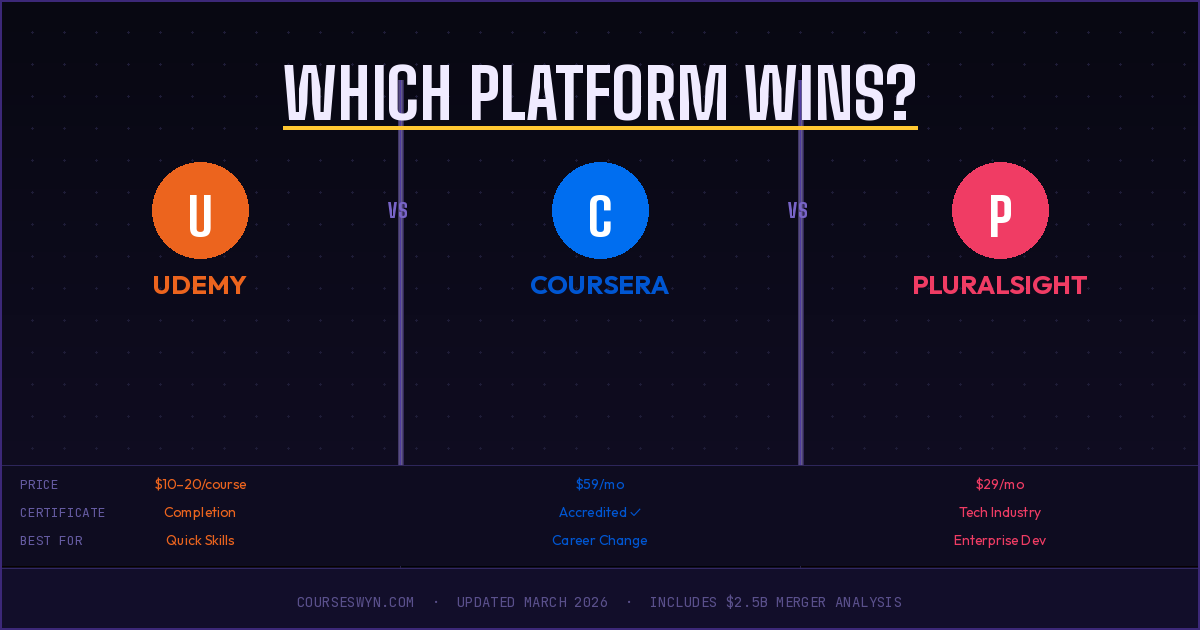
| Udemy | Coursera | Pluralsight | |
|---|---|---|---|
| Model | Pay-per-course | Subscription / per-course | Subscription |
| Best price | $10–$20 (on sale) | Free audit / $59/mo Plus | $29/mo Standard |
| Instructors | Independent creators | Universities + Google, IBM | Industry tech experts |
| Certificate value | Completion only (not accredited) | Employer-recognized | Completion + cert paths |
| Best for | Quick practical skills | Career change + credentials | Deep tech / enterprise |
| Course library | 210,000+ courses | 10,000+ programs | 6,500+ tech courses |
| Free option? | Yes (600+ free courses) | Yes (audit most courses) | 10-day free trial only |
Bottom line:
- Want to build a project this weekend? → Udemy
- Want a certificate that gets you hired? → Coursera
- Work in tech and need deep skill mastery? → Pluralsight
Table of Contents
- Udemy — The Marketplace Giant
- Coursera — The Academic Powerhouse
- Pluralsight — The Tech Skills Engine
- Head-to-Head Comparison by Category
- Who Should Choose What (By Goal)
- The $2.5B Coursera-Udemy Merger: What It Means for You
- Alternatives Worth Considering
- Frequently Asked Questions
1. Udemy — The Marketplace Giant
Best for: Beginners, budget learners, practical skill-building
Udemy is the YouTube of online education — massive, democratic, and occasionally inconsistent. With over 210,000 courses and 57 million learners, it’s the largest course marketplace in the world. Any qualified (or unqualified) instructor can publish a course, which is both its greatest strength and its biggest weakness.
What Makes Udemy Stand Out
Pay once, keep forever. Unlike subscription platforms, a Udemy purchase gives you lifetime access. Buy a Python course today and revisit it three years from now — still yours. This makes Udemy exceptional value when you catch courses on sale (often $10–$20 during frequent promotions).
Always current. Because anyone can publish, Udemy has courses on frameworks and tools released last month. No waiting for a university curriculum to catch up. If a new JavaScript library drops, a course appears within weeks.
Breadth is unmatched. From deep tech (Kubernetes, Rust, LLMs) to soft skills (public speaking, Photoshop, sourdough baking) — you’ll find it here.
Udemy’s Real Weaknesses
Quality varies wildly. Because there’s no academic gatekeeping, some courses are excellent and some are outdated or poorly produced. Always check: star rating (aim for 4.4+), number of reviews (1,000+ is a good signal), and when the course was last updated.
Certificates aren’t accredited. Udemy completion certificates are real, but they carry no academic accreditation. Employers know this. They’re fine for demonstrating initiative, but won’t replace a Google or IBM certificate for hiring purposes.
No learning path structure. Udemy doesn’t guide you from beginner to job-ready. You have to curate your own learning journey — which requires knowing what you need to learn. For the full platform verdict, see our Udemy Review 2026: Is It Still Worth It?.
Udemy Pricing in 2026
- Individual courses: Listed at $20–$200, but almost always discounted to $10–$20 during sales (which run constantly).
- Udemy Personal Plan: $16.58/month for access to 26,000+ curated courses — a subscription option Udemy launched to compete with Coursera and Pluralsight.
- Free courses: 600+ permanently free courses available directly on the platform.
- 100% off coupons: Instructors release free coupons daily — check CoursesWyn.com to grab premium courses at $0.
2. Coursera — The Academic Powerhouse
Best for: Career changers, credential seekers, structured learners
Coursera operates at the intersection of traditional academia and modern tech training. It partners with over 375 universities and companies — including Stanford, Yale, Google, and IBM — to deliver content that actually carries weight on a resume. With 191 million registered learners as of late 2025, it’s the platform of choice when credentials matter.
What Makes Coursera Stand Out
Employer-recognized certificates. The Google IT Support Professional Certificate, the IBM Data Science Certificate, the Meta Front-End Developer Certificate — these carry real-world recognition. Employers know these programs, which means they carry more hiring signal than most Udemy completions.
Degree programs. Coursera offers fully online Bachelor’s and Master’s degrees from real universities. These are rare in online learning and genuinely differentiated.
Structured learning with accountability. Coursera courses have deadlines, peer-reviewed assignments, and graded assessments. If you need external accountability to actually finish what you start, this structure helps.
Financial aid available. For learners who can’t afford the subscription, Coursera offers financial aid on most programs — making it accessible globally.
Coursera’s Real Weaknesses
It can feel theoretical. University-designed courses prioritize depth and rigor over quick practical application. If you want to build something this weekend, Coursera’s pacing will frustrate you.
Coursera Plus is expensive. At $59/month (or $399/year, though often discounted to ~$200/year), Coursera Plus is a significant commitment. Individual Specializations can run $40–$80/month.
Audit limitations. Coursera previously allowed free auditing of most courses. The platform has progressively restricted free access — you can still audit some courses, but the free option is less generous than it once was.
Coursera Pricing in 2026
- Individual courses: Free to audit (limited) / $49–$79 for a certificate
- Specializations: $39–$79/month per program
- Coursera Plus: $59/month or ~$399/year (often discounted to $199/year)
- Degrees: $9,000–$25,000 total depending on program
3. Pluralsight — The Tech Skills Engine
Best for: Working developers, IT professionals, enterprise teams
Pluralsight is the most focused platform on this list. It covers technology — and only technology. No cooking courses, no watercolor painting. Just 6,500+ courses across software development, cloud, IT ops, cybersecurity, data science, and AI. This focus makes Pluralsight the best platform for professionals who already know what they need to learn.
What Makes Pluralsight Stand Out
Skill assessments that benchmark you. Pluralsight’s IQ skill assessments are a killer feature. Before you start learning, the platform tests your current level across specific technologies and gives you a score. This tells you exactly where you stand and removes the guesswork of where to start.
Guided learning paths. Instead of picking random courses, Pluralsight builds learning paths toward specific roles: Cloud Architect, Full Stack Developer, Data Engineer. The platform connects what you know to what you need to learn next.
High production quality. Pluralsight’s instructors are vetted tech professionals — not random creators who figured out how to use screen recording software. Course quality is consistently high.
Hands-on labs and projects. The Premium plan includes interactive sandboxes where you practice skills in real environments without leaving the browser. This is a significant differentiator for certifications like AWS, Azure, and CompTIA.
Pluralsight’s Real Weaknesses
Subscription only — no lifetime access. Unlike Udemy, when you cancel your Pluralsight subscription, you lose access to everything. There’s no way to own a course permanently.
Only tech topics. If you want to learn business, communication, design, or anything outside the tech stack, Pluralsight isn’t for you.
Price. At $29/month for the Standard plan or $45/month for Premium (or $299/$449 annually), it’s the most expensive of the three for individual learners. The value proposition is stronger when an employer is paying.
Pluralsight Pricing in 2026
- Standard: $29/month or $299/year — core library of 2,500+ courses, skill assessments, paths
- Premium: $45/month or $449/year — full library 7,000+ courses, hands-on labs, interactive courses
- Business plans: $399–$779+/year for teams (2+ users)
- Free trial: 10-day free trial for both plans
4. Head-to-Head Comparison by Category
💰 Pricing & Value
Winner: Udemy for budget-conscious individual learners. At $10–$20 per course with lifetime access, the value is unmatched — especially if you grab 100% off coupons on CoursesWyn.
Coursera’s $199/year annual plan (when discounted) is excellent value if you’re actively pursuing certificates. Pluralsight’s $299/year is justified if your employer subsidizes it or if you’re deep into a tech certification track.
📜 Certificate Value
Winner: Coursera — by a significant margin. Google, IBM, and Meta certificates from Coursera are directly cited by hiring managers. Udemy’s completion certificates demonstrate initiative but carry no accreditation weight. Pluralsight certificates are respected within tech departments but less known outside them.
📚 Content Quality
Winner: Pluralsight for consistent quality. Every course is vetted. Coursera’s academic courses are rigorously designed. Udemy’s quality ranges from outstanding to outdated — it requires more due diligence on the learner’s part.
🔄 Content Freshness
Winner: Udemy — nothing keeps pace with a marketplace of 70,000+ instructors. If a new tool drops, a Udemy course appears within weeks.
🎯 Learning Structure
Winner: Coursera for guided career tracks. Pluralsight for role-based tech skill paths. Udemy has no built-in guidance — you curate your own path.
🛠️ Hands-On Learning
Winner: Pluralsight Premium — real sandbox environments are best-in-class for practice. Coursera offers graded projects. Udemy is primarily video-based.
5. Who Should Choose What (By Goal)
You want to learn a specific framework quickly (Next.js, FastAPI, LangChain) → Udemy. No other platform has this breadth of niche, current tutorials.
You’re switching careers and need a credential hiring managers trust → Coursera. The Google, IBM, and Meta certificates are your fastest path to a credentialed career change.
You work in tech and your company will pay for it → Pluralsight. The skill assessments, learning paths, and hands-on labs are unmatched for professional development.
You’re preparing for a cloud certification (AWS, Azure, GCP) → Pluralsight Premium for labs + Udemy for supplemental courses from instructors like Stephane Maarek.
You want a university degree online without attending campus → Coursera — the only platform here offering accredited bachelor’s and master’s degrees.
You’re on a tight budget → Udemy with coupons — build a premium curriculum for close to $0 using 100% off coupon codes.
You’re a complete beginner with no direction → Coursera — the structured Specializations guide you from zero to job-ready with clear milestones.
6. The $2.5B Coursera-Udemy Merger: What It Means for You
This is the most important section of this article for anyone making a platform decision right now.
On December 17, 2025, Coursera announced it is acquiring Udemy in an all-stock deal valued at approximately $2.5 billion. The deal is expected to close in the second half of 2026, pending regulatory and shareholder approval.
The combined entity will:
- Serve over 270 million registered learners globally
- Generate more than $1.5 billion in annual revenue
- Operate under the Coursera brand (Udemy’s brand may eventually be phased out or repositioned)
- Be headquartered in Mountain View, California, led by Coursera CEO Greg Hart
What this means for learners:
If you’re a current Udemy user: Your existing course library and lifetime access should be honored during the transition period. Long-term, Udemy’s open marketplace model may shift toward Coursera’s credentialed approach. The “buy once, keep forever” model could change after the deal closes.
If you’re deciding between them now: The merger suggests Coursera sees Udemy’s massive consumer reach as complementary to its credential-focused B2B business. For now, the two platforms operate independently. But if you want stability in 2026, Pluralsight is the most unaffected option.
The AI angle: Both companies cited AI skills training as a primary driver of the deal. The combined platform is expected to heavily expand AI-focused content — which is good news for learners pursuing AI/ML career tracks.
The merger doesn’t mean you shouldn’t use either platform today. But if you’re building a long-term learning stack, be aware that the Udemy you enroll in today may look different by 2027.
7. Alternatives Worth Considering
If none of the three main platforms fully fits your needs, these are worth a look:
LinkedIn Learning — Solid for soft skills and business topics. Integrates with your LinkedIn profile. ~$40/month, but often included free with LinkedIn Premium.
edX — Similar to Coursera but with a stronger free audit tradition. Offers MicroMasters and professional certificates from MIT, Harvard, and Berkeley.
Zero To Mastery (ZTM) — Community-focused, project-heavy coding bootcamp platform. Trustpilot rating of 4.9 vs. Udemy’s 1.7. Worth considering for web development, machine learning, and Python tracks.
Codecademy — Best for complete beginners learning to code interactively in the browser. More structured than Udemy, less academic than Coursera.
Frequently Asked Questions
Is Udemy or Coursera better for getting a job?
For getting hired, Coursera has the edge. Certificates from Google, IBM, Meta, and university partners are recognized by employers in a way that Udemy’s completion certificates are not. That said, Udemy is better for building the actual skills needed on the job — so many professionals use both.
Does Pluralsight give accredited certificates?
Pluralsight offers completion certificates, but like Udemy, they are not academically accredited. However, Pluralsight’s certification preparation paths (for AWS, Microsoft, CompTIA) and its skill assessments are well-regarded within the tech industry.
Is the Coursera-Udemy merger finalized?
As of March 2026, the merger is still pending regulatory and shareholder approval. Both companies continue to operate independently. The deal is expected to close in the second half of 2026.
Can I use Udemy for free?
Yes — through multiple methods. Udemy hosts 600+ permanently free courses. Additionally, instructors release 100% off coupon codes daily, which you can find on CoursesWyn.com. Coursera allows free auditing of many courses without a certificate.
Which platform is best for Python in 2026?
All three cover Python well. For the fastest, most practical introduction: Udemy (look for courses by Dr. Angela Yu or Jose Portilla). For a structured, credential-earning path: Coursera’s IBM Data Science or Google’s Python course. For advanced Python in a data engineering or cloud context: Pluralsight.
Is Pluralsight worth it in 2026?
For individual tech professionals paying out of pocket, it depends on your goals. The $299/year Standard plan is worth it if you’re actively pursuing a specific tech role or certification. If your employer pays, it’s a no-brainer — the skill assessments and learning paths alone justify the cost.
Final Verdict
There’s no universally “best” platform — only the best platform for your specific situation. Here’s the one-sentence summary for each:
- Udemy — The best value and most flexible option for learning specific practical skills fast, especially with discount coupons.
- Coursera — The best choice for credentials that hiring managers recognize and structured career-change programs.
- Pluralsight — The best platform for working tech professionals who need deep, vetted, role-specific skill development.
And if you’re cost-conscious? Start with free Udemy coupons from CoursesWyn, audit a Coursera Specialization for free, and evaluate Pluralsight during its 10-day trial — before spending a cent.