Table of Contents
- Model Context Protocol (MCP) Explained: The Backbone of Agentic AI Systems (2026)
- Why Model Context Matters in Agentic AI
- What Is the Model Context Protocol (MCP)?
- Core Components of MCP
- MCP in Single-Agent vs Multi-Agent Architectures
- MCP and Popular Agentic AI Frameworks
- Real-World Use Cases of MCP in 2026
- Risks and Limitations of MCP
- How MCP Supports SEO-Relevant Agentic AI Systems
- Conclusion
- Frequently Asked Questions
Model Context Protocol (MCP) Explained: The Backbone of Agentic AI Systems (2026)
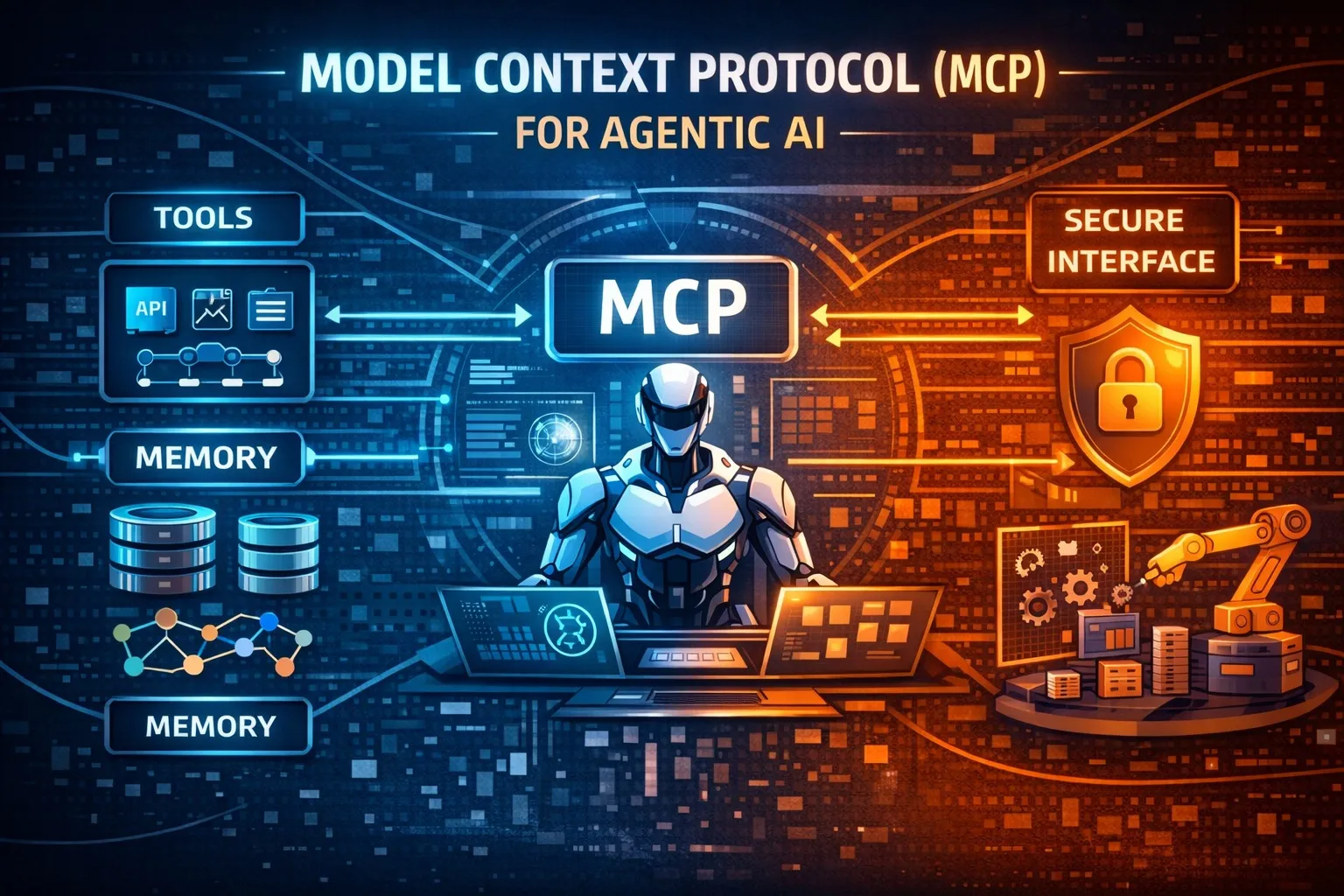
The Model Context Protocol (MCP) is a foundational standard that enables Agentic AI systems to safely and consistently interact with tools, memory, and external resources. As Agentic AI systems become more autonomous in 2026, MCP plays a critical role in separating reasoning from execution while preserving context integrity.
This article is part of the Agentic AI topical cluster and serves as a deep-dive reference for developers and architects building production-grade AI agents.
Related pillar: For a system-level overview, read What Is Agentic AI? Architecture, MCP, and Real-World Use Cases.
Why Model Context Matters in Agentic AI
Traditional AI integrations tightly couple models with tools and execution logic. This approach breaks down as systems scale. Agentic AI requires:
- Secure tool access
- Persistent and structured memory
- Clear boundaries between reasoning and action
- Interoperability across agents and services
MCP addresses these requirements by acting as a context interface layer between models and execution environments.
What Is the Model Context Protocol (MCP)?
MCP defines a standardized way for AI models to:
- Discover available tools
- Access memory stores
- Execute actions through controlled interfaces
- Maintain consistent context across steps and agents
Rather than embedding tool logic directly inside prompts or model wrappers, MCP externalizes execution while preserving semantic context.
Core Components of MCP
Context Providers
Context providers expose structured information to the model, such as:
- Available tools and capabilities
- Memory references
- Environmental constraints
This allows the model to reason about what it can do without direct access to execution code.
Tool Interfaces
MCP defines how tools are described, invoked, and validated. Tools can include APIs, databases, file systems, and execution runtimes.
Each tool is exposed with clear input and output schemas, enabling safe and predictable execution.
Memory Abstraction Layer
Memory in MCP-enabled systems is abstracted away from the model. The agent can read from and write to memory stores without knowing their implementation details.
This abstraction enables:
- Swappable memory backends
- Long-term knowledge persistence
- Cross-agent memory sharing
Execution Boundaries and Security
One of MCP’s most important roles is enforcing execution boundaries. Models cannot arbitrarily execute code or access resources.
Instead, all actions pass through MCP-controlled interfaces that support:
- Permission checks
- Rate limits
- Audit logging
MCP in Single-Agent vs Multi-Agent Architectures
MCP works in both single-agent and multi-agent systems.
Single-Agent Systems
In single-agent setups, MCP provides a clean separation between reasoning and execution, making systems easier to debug and secure.
Multi-Agent Systems
In multi-agent environments, MCP enables agents to share tools and memory while maintaining isolation. This is essential for collaborative systems built with frameworks like CrewAI and AutoGen.
MCP and Popular Agentic AI Frameworks
MCP and LangGraph
LangGraph uses graph-based execution models that align naturally with MCP. MCP handles tool access and memory, while LangGraph orchestrates planning and state transitions.
MCP and CrewAI
CrewAI focuses on role-based agent collaboration. MCP ensures each agent interacts with tools and memory through consistent, governed interfaces.
MCP and AutoGen
AutoGen emphasizes agent-to-agent communication. MCP provides a shared execution layer that prevents uncontrolled tool usage.
Real-World Use Cases of MCP in 2026
- Autonomous research agents with secure web and API access
- Enterprise workflow automation with auditability
- Long-running agents that require persistent memory
- Multi-agent systems with shared tools and governance
MCP enables these systems to scale safely beyond prototypes.
Risks and Limitations of MCP
While MCP improves safety and structure, it introduces complexity. Poorly designed context providers or overly permissive tool definitions can still lead to errors.
Effective MCP implementations require:
- Clear tool schemas
- Strict permission models
- Observability and logging
How MCP Supports SEO-Relevant Agentic AI Systems
For content-driven platforms and AI-powered applications, MCP enables agents to generate, update, and manage content responsibly. This is especially relevant for large authority sites and AI-assisted publishing workflows.
Conclusion
The Model Context Protocol is a critical enabler of Agentic AI in 2026. By standardizing how models interact with tools, memory, and execution environments, MCP makes autonomous AI systems safer, more scalable, and production-ready.
For readers exploring practical applications and learning paths, see our curated guide:
Frequently Asked Questions
What problem does MCP solve in Agentic AI?
MCP separates reasoning from execution, allowing AI agents to access tools and memory safely and consistently.
Is MCP required for Agentic AI systems?
While not mandatory, MCP or MCP-like abstractions are essential for building secure and scalable production systems.
Can MCP be used outside multi-agent systems?
Yes. MCP provides value in both single-agent and multi-agent architectures.