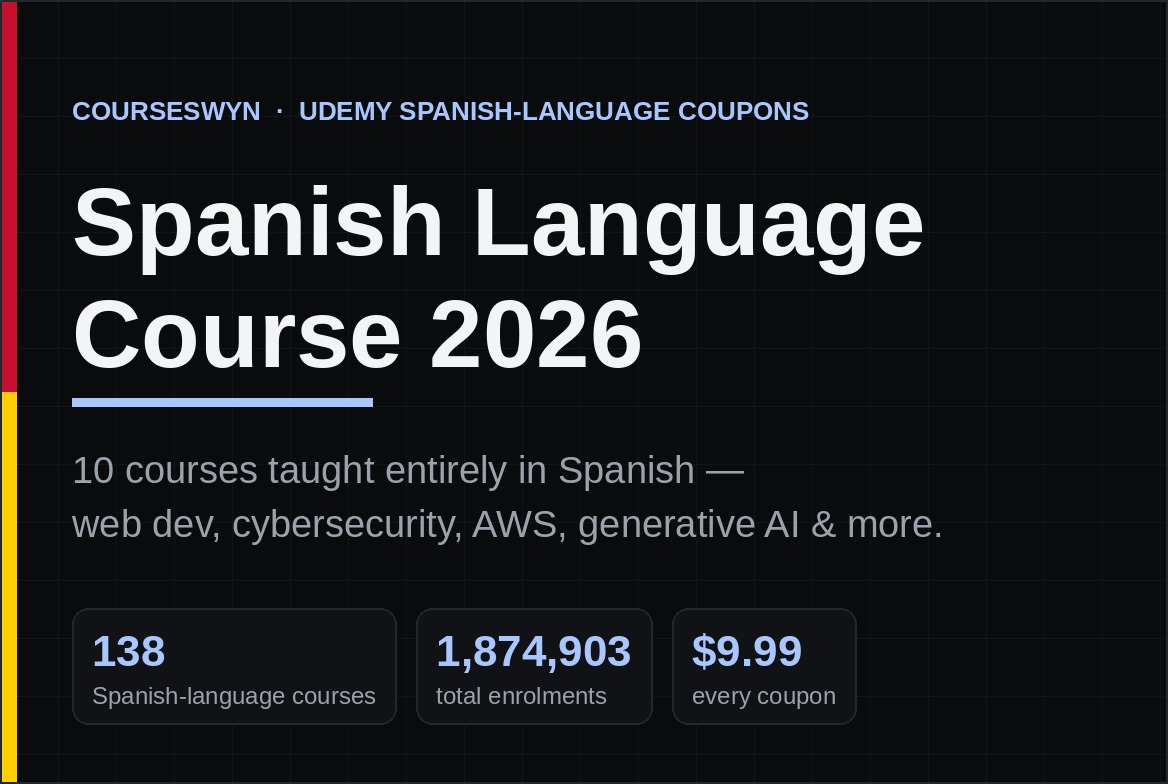
Quick answer: “Spanish language course” means two different things on Udemy, and only one of them sits in our coupon feed. Udemy’s own Spanish Language topic holds 486 courses that teach you Spanish, taken by 1,561,927 learners. Our live catalogue instead carries 138 professional courses taught in Spanish — web development, cybersecurity, AWS, generative AI, all narrated in Spanish. Every one is $9.99 with a working coupon, and the ten best below hold a combined 608,647 enrolments at ratings from 4.6 to 4.8.
The short version
This list is for two kinds of reader: Spanish speakers who would rather learn a professional skill in their own language, and intermediate Spanish learners who want real, spoken, technical Spanish instead of textbook dialogue. Both get the same thing — a course whose video, slides and explanation are entirely in Spanish, on a subject worth knowing.
Every figure below comes from our own catalogue of live Udemy coupons, refreshed with it. The rating, enrolment count, length and price on each card is what that course holds today, and the $9.99 coupon is already applied when you follow the link. The pros and cons are written by CoursesWyn’s editors from each course’s published syllabus and learning outcomes; the language of instruction is the field Udemy reports for the course, not an estimate we made. Nothing here is paid for.
All 10 courses at a glance
| # | Course | Best for | Rating | Students | Length | Price |
|---|---|---|---|---|---|---|
| 1 | Desarrollo Web Completo | A full route to a junior web job | 4.6 | 173,223 | 82h 30m | $9.99 |
| 2 | Programación para principiantes | First contact with code in Spanish | 4.8 | 121,586 | 7h 49m | $9.99 |
| 3 | Angular: De cero a experto | Front-end frameworks | 4.8 | 75,076 | 33h 32m | $9.99 |
| 4 | JavaScript Moderno | Deepening modern JS | 4.8 | 35,476 | 20h 53m | $9.99 |
| 5 | Hacking Ético y Ciberseguridad | Security fundamentals | 4.7 | 58,779 | 21h | $9.99 |
| 6 | AWS Cloud Practitioner CLF-C02 | A first cloud certificate | 4.8 | 47,922 | 18h 51m | $9.99 |
| 7 | IA Generativa: ChatGPT, Midjourney | Generative AI breadth | 4.7 | 45,510 | 22h | $9.99 |
| 8 | n8n + MCP | AI agents and automation | 4.8 | 25,400 | 18h 57m | $9.99 |
| 9 | Microsoft Copilot 365 | Office productivity | 4.6 | 21,558 | 7h 30m | $9.99 |
| 10 | Lean Six Sigma | Process improvement certs | 4.7 | 4,117 | 12h 22m | $9.99 |
Between them these ten carry 608,647 enrolments and about 240 hours of Spanish-language instruction. The lowest rated sits at 4.6, the rest at 4.7 or better, and all ten cost $9.99 with a working coupon.
How to pick
- You want a job in web development: Desarrollo Web Completo. It is the only single course here that covers HTML, CSS, JavaScript, PHP and MySQL end to end with four finished projects.
- You have never written a line of code: Programación para principiantes, at under eight hours, before anything else on this page.
- You already code and want a framework: Angular: De cero a experto for front-end work, or React Native / Flutter elsewhere in the catalogue if you prefer mobile.
- You want your Spanish and your JavaScript to improve together: JavaScript Moderno — modern syntax, Vite, modules and Node, explained in steady, clearly spoken Spanish.
- You are moving into security: Curso completo de Hacking Ético y Ciberseguridad, which uses Kali Linux and real attack exercises rather than slides.
- You want a certificate with your name on it: AWS Certified Cloud Practitioner, updated for CLF-C02 with a full practice exam included.
- You want generative AI breadth: Curso Completo de IA Generativa, covering ChatGPT, DeepSeek, Claude, Gemini, Midjourney and prompt engineering.
- You want to build things rather than read about them: n8n + MCP, which ends with working agents, bots and a RAG system you have set up yourself.
- You live in Microsoft 365 all day: Microsoft Copilot 365, seven and a half hours across Word, Excel, PowerPoint, Outlook and Teams.
- You are after a process-improvement credential: Lean Six Sigma, which prepares White, Yellow, Green and Black Belt in one sitting.
Web development and programming in Spanish
1. Desarrollo Web Completo con HTML5, CSS3, JS AJAX PHP y MySQL

Juan Pablo De la torre’s course is the largest Spanish-language course in our catalogue by a wide margin: 173,223 students, 82h 30m of instruction, and four finished projects you can put in a portfolio. It runs from HTML and CSS — including modern methodology such as BEM — into JavaScript ES6, then PHP and MySQL for dynamic sites, CRUD applications and PayPal checkout. It assumes nothing: no HTML, no CSS, no programming at all, and it ends with a portfolio aimed at junior developer applications.
Best for: the shortest path from zero Spanish-language coding to an employable portfolio.
Pros
- 173,223 enrolled students, the largest audience of any Spanish-language course we track
- 82h 30m — deep enough to be a single course instead of a stack of tutorials
- Four complete projects, including a working CRUD app with payment integration
- No prior experience required in HTML, CSS or programming
Cons
- 82h 30m is a genuine commitment; expect months, not weekends
- PHP and MySQL is a traditional stack, not the newest front-end path
- So broad that it rewards finishing, and punishes stopping halfway
2. Programación para principiantes - Primeros pasos

Fernando Herrera’s course is the gentlest entry on this page and the second largest: 121,586 students at 4.8, in just 7h 49m. It teaches programming fundamentals rather than a language — logic, terminology, how to break a problem down — using JavaScript and TypeScript as the vehicle. If your Spanish is fine but the idea of code is not, this is where to start, because nothing here assumes you already think like a developer.
Best for: complete beginners who want the reasoning skill before the syntax.
Pros
- 7h 49m — short enough to finish and still feel the difference
- 4.8 from 121,586 students, the highest-rated course in this list
- Teaches logic and problem framing, which transfer to any language later
- Uses JavaScript and TypeScript, so the follow-on courses are ready-made
Cons
- Deliberately shallow: it will not make you employable on its own
- Requires installing software locally, so it needs a real computer and admin rights
- No project portfolio — pair it with Desarrollo Web Completo afterwards
3. Angular: De cero a experto

33h 32m of Angular from Fernando Herrera, holding 4.8 across 75,076 students. The syllabus is current rather than archival: signals, components, services, zoneless change detection, maps, authentication, file uploads, deployment, and Git and GitHub alongside them. It asks only for basic JavaScript and basic programming knowledge — no TypeScript and no prior Angular — and it teaches Angular through TypeScript as it goes.
Best for: front-end developers who want the framework explained once, properly, in Spanish.
Pros
- 75,076 students at 4.8 — the strongest rating-plus-scale combination in this list
- Current Angular: signals and zoneless, not an older version reuploaded
- Git, GitHub and deployment covered inside the course rather than left out
- TypeScript taught through use, so you do not need it beforehand
Cons
- Wants basic JavaScript first — genuinely not a first course
- Angular-specific, so the investment does not transfer to React
- 33h 32m of framework detail is dense if you only build occasional apps
4. JavaScript Moderno: Guía para dominar el lenguaje

A companion to the beginner course from the same instructor, and a prerequisite for the Angular one: 20h 53m, 4.8, 35,476 students. It covers the modern language rather than a framework — classes, private properties, ESNext syntax, module imports, Vite, hot reload, Node, npm, plus a CRUD build and file uploads. Herrera’s Spanish is unhurried and his pacing is even, which is a large part of why the course sits at 4.8.
Best for: anyone who already writes some JavaScript and wants the current version of the language.
Pros
- Modern toolchain: Vite, ESNext, modules and Node rather than legacy scripts
- 20h 53m of focused language work without framework distraction
- 4.8 from 35,476 students
- Builds a real CRUD project, so the syntax lands somewhere concrete
Cons
- Recommends basic programming knowledge already — not a first-ever course
- No framework coverage, so it stops short of building a full application
- Much of it is syntax reference, which is dry if you prefer projects
Cybersecurity and cloud certification in Spanish
5. Curso completo de Hacking Ético y Ciberseguridad

Santiago Hernández’s course is the largest security title in the Spanish-language set: 58,779 students, 21h, 4.7. It works with Kali Linux and its tooling, remote exploitation against Windows and Linux targets in a controlled environment, offensive security fundamentals, and — unusually — the application of machine learning techniques to attacking. It assumes only basic IT knowledge, and the whole thing is delivered in Spanish, which is rare for security material at this depth.
Best for: Spanish speakers who find English-language security material slows them down.
Pros
- 58,779 students, the biggest Spanish-language cybersecurity course we carry
- Hands-on: Kali Linux, live exercises and remote exploitation, not slides
- 21h is substantial without being unfinishable
- Covers machine learning applied to attacking, which most beginner security courses skip
Cons
- Needs basic IT knowledge before you start
- Practice targets must be set up locally, so it is not a watch-only course
- Security material ages fast; check the last-update date before buying
6. [Español] AWS Certified Cloud Practitioner (CLF-C02) - 2026

Joan Amengual and Stephane Maarek’s Spanish-language CLF-C02 course has 47,922 students at 4.8 and 18h 51m. It covers the AWS fundamentals the exam asks for — EC2, elastic load balancing, auto scaling, RDS, ElastiCache and S3 — with a complete practice exam including explanations and more than 500 slides downloadable as PDF. There are no prerequisites and no cloud experience assumed; the exercises run on the AWS free tier.
Best for: a first cloud certificate taken in Spanish, without English exam-prep friction.
Pros
- Aligned to the current CLF-C02 exam blueprint
- Full practice exam with explanations, plus 500+ slides as PDF
- Free-tier labs, so practice costs nothing beyond the course
- Amengual teaches in Spanish; Maarek’s material is the same used in the English version
Cons
- Prepares you for one foundational exam, not for a job on its own
- Service-by-service pacing gets repetitive if you already know the basics
- The certification is entry-level, so it opens doors rather than deciding them
Generative AI and automation in Spanish
7. Curso Completo de IA Generativa: ChatGPT, Midjourney y más!

Santiago Hernández again, this time on generative AI: 22h, 4.7, 45,510 students. The coverage is deliberately wide — ChatGPT 4 and o1 used professionally, custom GPTs and the apps built on them, DeepSeek, Claude, Copilot and Gemini, prompt engineering at both basic and advanced level, what large language models actually are, and Midjourney and Stable Diffusion for images. No prior experience is required.
Best for: a single Spanish-language survey of the whole generative AI toolset.
Pros
- 45,510 students at 4.7 — well tested by Spanish-speaking learners
- Breadth: ChatGPT, Claude, Gemini, DeepSeek, Copilot, Midjourney and Stable Diffusion
- Prompt engineering and LLM fundamentals taught explicitly, not assumed
- No prerequisites at all
Cons
- Breadth means shallow coverage of each tool; it will not make you an engineer
- Tool versions move constantly, so check when it was last updated
- Largely awareness-level content for people who already work in something else
8. n8n + MCP: Automatización y agentes de IA inteligentes

The most current course in this list, and the most build-oriented: 18h 57m of n8n and Model Context Protocol at 4.8 from 25,400 students. You wire complete workflows across Google Sheets, Gmail, external APIs and databases; build agents on MCP that reach real tools; and finish with chatbots, scraping, Telegram and WhatsApp bots, voice agents, and a RAG system over PostgreSQL and Google Drive. It starts from zero, so no automation or AI background is needed.
Best for: people who would rather have a working agent at the end than a page of notes.
Pros
- Produces finished artefacts: bots, scrapers, a RAG setup, working agents
- MCP covered properly, which most n8n courses still leave out
- 4.8 from 25,400 students, the top rating in this list
- Starts at the basics, so no automation experience is required
Cons
- Local installation of n8n and its dependencies, so a real machine is needed
- Fast-moving area: connectors and model behaviour change between releases
- Automation logic transfers, but the specific tooling is n8n-shaped
Productivity and business in Spanish
9. Curso Microsoft Copilot 365. IA Generativa en Microsoft 365

Ivan AlsiGo’s course is the shortest on this page at 7h 30m, and the most immediately useful for office work: 4.6 from 21,558 students. It treats Copilot as an everyday assistant inside Microsoft 365 — drafting and editing in Word, building and automating slides in PowerPoint, sorting mail and schedule in Outlook, sharpening collaboration in Teams, and the spreadsheet work in Excel, extending to Power Platform. No prior experience is required.
Best for: anyone whose working day already takes place inside Microsoft 365.
Pros
- 7h 30m — the easiest course here to fit around a job
- Covers the whole M365 surface: Word, Excel, PowerPoint, Outlook, Teams
- Practical output: documents, decks and mail handled faster from week one
- 21,558 students at 4.6
Cons
- Needs a Microsoft 365 licence to practise properly, which is a separate cost
- Copilot changes often, so parts of the interface may have moved on
- Teaches one vendor’s assistant, not transferable AI skill
10. Curso Completo de Lean Six Sigma - Prepara 4 Certificaciones

The smallest audience here by enrolment — 4,117 students — and the only Business course in the Spanish-language set, but the most structured credential path: 12h 22m, 4.7, preparing White, Yellow, Green and Black Belt at once. It runs from Lean Six Sigma foundations through the DMAIC cycle, waste elimination, statistical and quality tools, data-driven problem solving and project leadership, with no prerequisites. For Spanish-speaking professionals in operations or quality, it is the clearest certification route in this catalogue.
Best for: operations and quality professionals who need a recognised credential in Spanish.
Pros
- Four certification levels prepared in a single course
- DMAIC, statistical tools and quality tools taught as one continuous method
- 4.7 — tied for the best rating in this list
- No prior knowledge assumed, so it starts genuinely from zero
Cons
- 4,117 students, far fewer reviews to judge it by than the others here
- The certification exams themselves sit outside the course and cost extra
- Dry, statistics-heavy material if you are not working in operations
Why take a course in Spanish at all?
Two reasons, and they are not the same reason.
If you are a Spanish speaker, the question barely needs asking: technical English is a real tax on learning. A concept you would absorb in four minutes in Spanish takes twenty in a language you are still translating in your head, and by minute twenty you have lost the concept rather than learned it. The Spanish-language catalogue exists because the demand is there — 1,874,903 enrolments across 138 courses is not a niche.
If you are learning Spanish, a technical course is the best kind of input you can find. Coursebook dialogue teaches you to order coffee; a web development course teaches you to follow forty minutes of continuous, purposeful explanation, which is roughly the skill you actually need. Research on language acquisition is consistent that comprehensible input on a subject you care about beats graded dialogues you do not — and caring about the subject is the whole trick.
The honest limit: this is practice, not tuition. Nobody learns Spanish for the first time from an Angular course. If you are below about B1, take a language course first and come back; from B1 upward, switching one technical subject to Spanish is the fastest way to find out how much you really understand.
What the numbers say about our Spanish-language catalogue
- 138 courses carry Spanish as their language of instruction, out of 1,453 live deals in our feed
- 1,874,903 enrolments in total, averaging 4.67 stars
- Every one is $9.99 with a working coupon — no Spanish-language course in the feed sits outside that price
- Split by field: Development 87, IT & Software 35, Office Productivity 14, Business 2
- The ten courses above hold 608,647 of those enrolments between them
That distribution tells you where Spanish-language instruction actually exists on Udemy: overwhelmingly software, with security and cloud behind it, and comparatively little in the softer business subjects. If you want Spanish-language material on marketing or design, you will find thinner pickings than the Development shelf.
Where to go next
- Development coupons — the full live shelf, of which the four development courses above are the leading edge
- IT & Software coupons — security, cloud and certification material, Spanish and English alike
- Business coupons — where the Lean Six Sigma course sits
- Udemy coupon code page — the day’s whole catalogue, refreshed as coupons rotate
Frequently Asked Questions
What is a Spanish language course?
A course delivered in Spanish — narration, slides and materials all in Spanish. On Udemy the phrase pulls two different searches, and it is worth being precise: a course that teaches Spanish, and a course on another subject taught in Spanish. This page is the second kind, taken from our live coupon feed.
What is the difference between learning Spanish and taking a course in Spanish?
The subject changes, and so does the skill you build. Learning Spanish makes the language itself the topic — grammar, pronunciation, conversation. Taking a course in Spanish makes the topic something else entirely, and Spanish becomes the medium you have to keep up with. One builds the language; the other tests whether you have it.
Does Udemy teach Spanish?
Yes — 486 courses, 1,561,927 learners, average rating 4.6, on Udemy’s Spanish Language topic. Those teach the language to you. Our coupon feed does not currently carry them, so if that is what you are after, start there rather than with the courses on this page.
How many Udemy courses are taught in Spanish?
138 in our live catalogue, totalling 1,874,903 enrolments at an average of 4.67 stars: 87 in Development, 35 in IT & Software, 14 in Office Productivity and 2 in Business.
How much does a Spanish-language Udemy course cost?
$9.99. All 138 Spanish-language courses in our feed are priced there with a working coupon, against original prices of $149.99 or $199.99. The discount is applied automatically when you follow the card link.
Which is the best course taught in Spanish on Udemy?
Desarrollo Web Completo con HTML5, CSS3, JS AJAX PHP y MySQL — 173,223 students, 4.6 rating, 82h 30m. If you want the highest-rated instead of the largest, Programación para principiantes and JavaScript Moderno both sit at 4.8.
Are courses taught in Spanish good for learning the language?
They are good practice and poor tuition. Following forty minutes of technical Spanish trains listening and vocabulary on material you care about, which is exactly why it works as input. It will not teach you Spanish from nothing, though — take a language course to about B1, then switch a technical subject over to Spanish.
Do I need a high Spanish level to take a course in Spanish?
Roughly B1 for the shorter, visual courses and B2 for the dense 80-hour ones. You need enough to follow a spoken explanation and read a slide without stopping. None of these courses teach Spanish, so an absolute beginner will not be able to keep up.
What is the best beginner course in Spanish?
Programación para principiantes - Primeros pasos — 7h 49m, 4.8, 121,586 students. It assumes no programming and speaks plainly and quickly, which makes it the gentlest landing if your Spanish is decent and your coding has not started yet.
Do these Spanish-language courses include a certificate?
Yes. Every course on this page carries Udemy’s certificate of completion, issued once you have watched the required share of the videos. It is issued by Udemy — it is not a language certification and not the AWS or Lean Six Sigma credential named in a course title.